CE Metzger Issues Executive Order Affirming Climate Commitment
Published on February 09, 2026
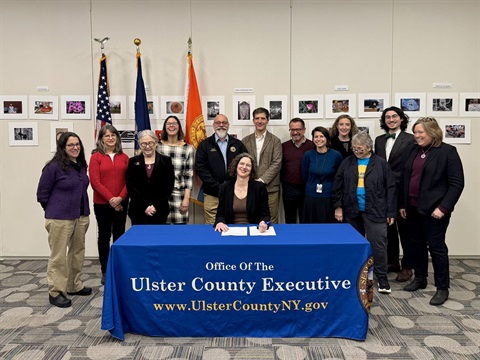
County Executive Metzger Issues Executive Order Affirming Climate Commitment in Wake of Federal Roll Back — Establishes Climate Smart Community Task Force & Local Government Climate Partnership
KINGSTON, NY - Ulster County Executive Jen Metzger today affirmed the County’s commitment to address climate change with an Executive Order that builds on the Executive Order she issued three years ago to align the County’s actions with the NYS Climate Act. The Executive Order issued today establishes two bodies to advance the County’s climate work: a Climate Smart Community Task Force and a Local Government Climate Action Partnership through the Ulster County Environmental Management Council.
The new Climate Smart Task Force, to be composed of County departments and partner organizations, will guide and coordinate climate change mitigation and resiliency initiatives, oversee renewal of the County’s Silver-level certification as an NYS Climate Smart Community, identify and prioritize climate‑smart projects, engage residents and stakeholders and advance the County’s forthcoming Community Climate Action Plan.
The second body, the Local Government Climate Action Partnership, will be created by the Ulster County Environmental Management Council as a subcommittee to promote best practices for reducing greenhouse gas (GHG) emissions and adapting to climate change. The Department of the Environment will provide administrative support to the subcommittee, and the County has also contracted with the Hudson Valley Regional Council to provide additional technical support to local governments.
The Executive Order comes at a time when the federal government has abandoned major climate initiatives and rolled back key environmental protections, creating uncertainty for states and local governments. Last year, the federal budget eliminated $569 billion in climate and clean energy funding. The Trump administration has also moved to weaken and rescind core climate regulations through executive orders and agency directives, including seeking to overturn the EPA’s 2009 endangerment finding that GHG emissions threaten public health — the legal foundation for regulations reducing those emissions. In November, the Trump administration announced plans to open more than 1.3 billion acres of federal lands to oil and gas drilling while seeking to halt states’ offshore wind development plans, including a project off the coast of Montauk that would generate enough renewable energy to power nearly 600,000 New York homes. (The project is half completed, and last week a federal judge ordered a preliminary injunction allowing construction to continue.)
“At a time when the federal government has walked away from national and global efforts to avoid the severe consequences of run-away climate change, Ulster County remains steadfast in its commitment to reduce harmful emissions and build climate resilience in our communities," said County Executive Jen Metzger. “We know what’s at stake for our communities, our economy, and future generations, and we also know that climate solutions have other benefits, like protecting public health and reducing energy bills. Local leadership has never mattered more, and Ulster County will continue to lead by example. We’re proud of the progress we’ve made, and we’re not slowing down.”
“I strongly support this renewed commitment to climate action,” said Kristen Schara, Ulster County Environmental Management Council Chair. “Executive Order 03-2026 reinforces the County’s leadership and keeps us on a clear path toward a safer, more resilient future.”
“This executive order creates an essential support system for climate action across Ulster County. The Climate Smart Communities Task Force will serve as a resource for our departments and municipalities, helping them navigate the challenges of meeting ambitious climate goals,” said Peter Criswell, Chair of the Ulster County Legislature. “Our communities are on the front lines of climate action, and this task force will provide the technical assistance, coordination, and shared expertise they need to succeed. Working together, we can accelerate progress toward our emissions reduction targets while ensuring no community is left behind in the transition to a sustainable future.”
“As a new County Legislator, I am happy to see the commitment from our County Executive Jen Metzger to working on the important issues we face related to climate change,” said Legislator Amy Dooley (D-9, Highland/Esopus), a member of the Legislature’s Energy, Environment & Sustainability Committee. “This Executive Order will help municipalities to take advantage of help in implementing climate initiatives in their communities.”
"It is heartening to see Ulster County Executive Jen Metzger leading the way towards a more sustainable and affordable future while helping local towns adopt best practices for climate action and resiliency," said Betta Broad, campaign director of New Yorkers for Clean Power. "Ulster County is supporting the transition to clean energy, from deploying more electric buses to assisting residents of mobile homes who no longer have to rely on costly propane for heating, and upgrading the HVAC system of the Restorative Justice Center; County leaders are future-proofing wherever possible, which means less reliance on importing expensive and polluting fossil fuels."
Ulster County’s Climate Progress Since 2023
Since the issuance of Executive Order 1 in 2023, Ulster County has made significant, measurable progress toward reducing emissions, modernizing infrastructure, and expanding clean energy.
Green Fleet Leadership
- Exceeded the 2025 Green Fleet target early, reaching 22% green vehicles in 2024 and further outpacing the target with over 25% of green vehicles in 2025.
- Over 80% of all light‑duty fleet purchases in 2025 were green vehicles.
- Added 21 fully electric vehicles, 31 plug‑in hybrids, and 1 hybrid to the fleet since 2023.
- Expanded UCAT's electric fleet, which includes five electric buses and more hybrid and electric buses arriving in 2026.
- Installed 91 EV charging plugs across County facilities, with major fast‑charging hubs in Kingston, Ellenville, and the Department of Social Services.
- Deployed an off‑grid EV ARC™ solar‑powered charging station, now located at the Ashokan Rail Trail.
Clean Energy & Building Decarbonization
- Electrified the Probation Building, in Kingston, eliminating natural gas use entirely.
- Installed rooftop solar at the Hall of Records and UCAT, supporting on‑site renewable energy generation.
- Upgraded UCAT’s “Bus Depot of the Future” with 12 DC fast chargers, Level 2 chargers, solar generation, and resiliency infrastructure.
- Conducted additional energy audits and implemented conservation measures that saved $111,900 in 2024, with projected annual savings of $384,000.
- Completed major LED lighting retrofits, including thousands of fixtures at the Department of Social Services.
County Government Emissions Reductions
- Reduced greenhouse gas emissions from County operations by over 29% since 2012.
- County buildings now use 15% less energy per square foot than in 2012 and 6% less than in 2023.
- Emissions from benchmarked buildings have dropped 30% since 2012 and 11% since 2023.
- 16% of electricity used in County buildings now comes from on‑site solar.
Planning, Policy & Waste Reduction
- Launched a Community Climate Action Plan, to be finalized this summer.
- Strengthened the County’s Sustainable Purchasing Policy, including expanded use of recycled materials and an end to use of single-use plastics by government.
- Expanded organics diversion program at County facilities.
- Created the first-in-the-nation County Decarbonization Fund in 2024 — an $18 million capital reserve supporting building energy efficiency and electrification.
Involving Young People in the Solutions
- Created the Ulster County Climate Corps — now in its fourth year. This paid, project-based summer internship program provides high school and college students with hands-on experience working on climate solutions in County departments. Interns contribute directly to advancing the directives of the 2023 Executive Order, including projects on sustainable farming, climate hazard mitigation planning, clean-energy mapping, waste reduction, and youth climate education.